Back to News
Migration of mission-critical Oracle databases to AWS, Azure, or Google Cloud – comparing platform options
February 9, 2026
Technical SeriesShare with


When migrating mission-critical Oracle databases from an on-premises data center to a public cloud, organizations must choose from several platform options for on-cloud database architecture. This article compares all practical options available for migrating to AWS, Azure, and Google Cloud, while highlighting the key strengths, limitations, and usage scenarios for each option. Its purpose is to provide reference material to help Database and Cloud Architects design new database architectures in the cloud.
The article covers the following options:
- Self-managed database on cloud-native compute instances
- Oracle Database@ AWS / Azure / Google Cloud
- FlashGrid Cluster
- FlashGrid Server Amazon RDS for Oracle
- Amazon RDS Custom for Oracle
Notes:
- The article does not cover the following platform options due to apparent lack of customer traction and/or vendor endorsement: VMware Cloud on AWS, Azure VMware Solution, Google Cloud VMware Engine, Google Cloud Bare Metal Solution.
- The article assumes that the reader’s intention is to continue using Oracle Database. It does not cover options for migrating to other database engines.
- Oracle Database licensing questions are out of this article’s scope due to large differences between various licensing arrangements that Oracle customers have.
Self-managed database on cloud-native compute instances
With this approach, the customer is responsible for deployment, validation, and maintenance of Oracle databases on AWS EC2 instances, Azure VM instances, Google Compute Engine instances, or similar compute instances in any other public cloud. It is the most similar to having an on-premises Oracle database setup on standard (non-Exadata) servers.
Key strengths:
- No dependency on any advanced services or infrastructure beyond the basic cloud-native compute instances and storage.
- Full control of the database home, grid home, and the operating system.
- Portability between any clouds and on-premises.
Key limitations:
- Customer has responsibility for properly configuring, validating, and maintaining the cloud instances, the operating system, and the database and grid home software.
- Self-managed database HA, DR, and backup.
- Self-managed software updates.
- Higher risk of misconfiguration and unexpected failures, especially with mission-critical systems that require high availability.
- Performance is limited by the storage throughput of a single cloud instance.
- Implementing Oracle RAC for high availability is overly complex unless using an engineered software solution for shared storage and specific network capabilities.
Key usage scenarios:
- Non-critical databases
- Legacy (end of support) database versions
- Highly customized systems
Oracle Database@AWS / Oracle Database@Azure / Oracle Database@Google Cloud
The Oracle Database@ family of services brings Exadata capabilities to AWS, Azure, and Google clouds by placing Oracle Cloud Infrastructure (OCI) “child sites” within AWS, Azure, and Google Cloud data centers. The services include Exadata Database Service on Dedicated Exadata Infrastructure, Exadata Database Service on Exascale Infrastructure, Autonomous AI Database Serverless, Autonomous AI Database Dedicated, and Base Database Service. These range from mostly self-managed database and infrastructure to fully managed DBaaS. The exact list of available services varies by cloud and may change over time.
Key strengths:
- Broad range of database service options
- All performance features of Exadata systems, especially for extra-large data warehouse scenarios.
- Full database management automation with Autonomous AI Database.
- AI capabilities, such as natural language processing, with Autonomous AI Database.
- On-demand Oracle Database licensing is available
Key limitations:
- Extra complexity and effort for connecting and maintaining two clouds (the primary cloud + OCI).
- Risk of deeper vendor lock-in through the increased dependency on proprietary Exadata and OCI features.
- Higher exposure to data center outages because the Oracle Database@ services do not allow spanning an Oracle RAC cluster across AZs. Resilience to AZ loss with zero RPO requires provisioning a standby Oracle RAC cluster in a second AZ (if available) of the same region.
- Limited HA and DR configuration options due to limited service availability by cloud regions and AZs (in some regions available in a single AZ only)
Key usage scenarios:
- Extra-large (100’s of TB) data warehouses on Dedicated Exadata Infrastructure.
- Consolidation of multiple smaller databases on shared Exadata Exascale Infrastructure.
- Simplified management of non-critical and test/dev databases with Autonomous AI Database.
- Lift-and-shift of databases whose performance heavily relies on proprietary Exadata features (Smart Scan, HCC, etc.)
- Lift-and-shift of Oracle RAC databases
FlashGrid Cluster
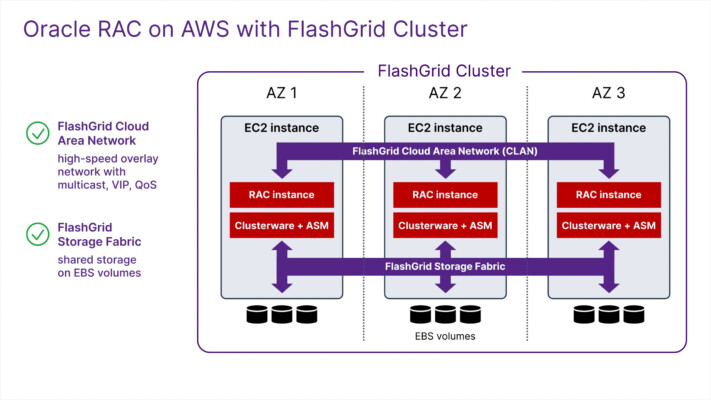
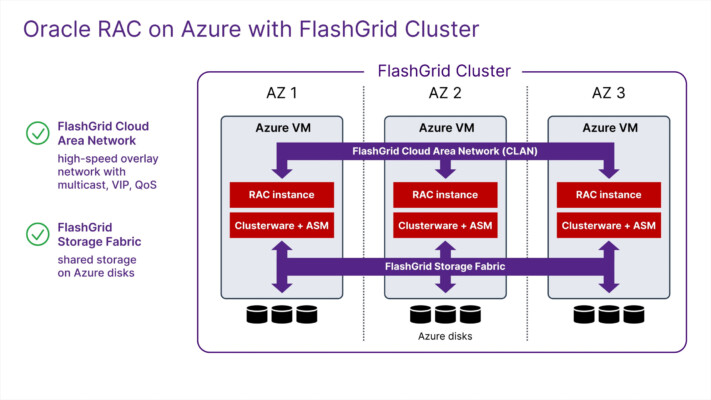
While not a separate cloud platform per se, FlashGrid Cluster enhances the storage and network capabilities of the native cloud compute instances to enable Oracle RAC and Failover HA clustering. It is an open virtual clustered database appliance that provides Infrastructure-as-Code deployment automation, interoperability and reliability validation, and technical support for the entire infrastructure stack. This puts FlashGrid Cluster in between the self-managed database and DBaaS models.
Key strengths:
- The simplest solution for running Oracle RAC on cloud-native compute instances
- Protection against data center outages with Multi-AZ RAC clustering
- Customer has full control of the database home, grid home, OS
- Available in all regions of AWS, Azure, Google Cloud
Key limitations:
- Self-managed DR and database backup
- Self-managed software updates
Key usage scenarios:
- Lift-and-shift of Oracle RAC databases
- Mission-critical databases with uptime SLA requirements of 99.99% or higher (achievable with FlashGrid architecture, not a contractual SLA by FlashGrid).
FlashGrid Server
FlashGrid Server is a virtual appliance for running Oracle databases in the cloud. It simplifies single-instance Oracle database deployment on cloud compute instances by providing a packaged solution with Infrastructure-as-Code automation, OS and infrastructure configuration best practices, and 24/7 support of the entire infrastructure stack. This puts FlashGrid Server in between the self-managed database and DBaaS models.
Key strengths:
- Infrastructure-as-Code automation of the deployment process
- Implements best practices for OS and infrastructure configuration
- Rapid failure isolation for Data Guard Fast-Start Failover (FSFO) configurations
- Customer has full control of the database home, grid home, OS
- Available in all regions of AWS, Azure, Google Cloud
Key limitations:
- Self-managed HA (typically Oracle Data Guard replication with FSFO)
- Self-managed DR and database backup
- Self-managed software updates
- Limited to single-instance databases
Key usage scenarios:
- Lift-and-shift of single-instance Oracle databases
- Non-critical databases that do not require HA
- Enhanced reliability and HA in Data Guard FSFO configurations
Amazon RDS for Oracle
Amazon RDS for Oracle is a fully managed Database-as-a-Service (DBaaS) offering that simplifies running Oracle databases on AWS by automating deployment and offloading routine maintenance tasks to AWS.
Key strengths:
- The simplest option with the lowest entry barrier
- Routine maintenance tasks offloaded to AWS: database backup, patching, HA replication
Key limitations:
- Available on AWS only
- AWS-specific management API with no portability to other clouds or to on-premises
- Throughput limited by a single compute instance
- Some Oracle Database features unsupported, e.g. Oracle RAC and Flashback Database
- No access to the OS and to certain database system procedures and tables
Key usage scenarios:
- Non-critical databases on AWS
- Fast implementation with minimal resources
Amazon RDS Custom for Oracle
Amazon RDS Custom for Oracle offers a middle ground between a self-managed Oracle and a fully managed Database-as-a-Service (DBaaS). It combines the automation of Amazon RDS with access to the OS, to the database home, and to database system procedures and tables.
Key strengths:
- Routine maintenance tasks offloaded to AWS: database backup, patching, HA replication
- Customizations (within operational guardrails) that are not allowed with regular Amazon RDS
Key limitations:
- Available on AWS only
- AWS-specific management API with no portability to other clouds or to on-premises
- Throughput limited by a single compute instance
- Some Oracle Database features unsupported, e.g. Oracle RAC and Flashback Database
Key usage scenarios:
- Non-critical databases on AWS
- Legacy, custom, and packaged applications that require access to the underlying operating system and database environment
Share with
Subscribe to our updates

Subscribe to our updates
Related case studies


How FlashGrid’s Go-Live Review helped a U.S. Government Agency expand Oracle RAC deployments on AWS


International Metal Processing Equipment Manufacturer Simplifies Database HA with FlashGrid on Azure

Leading SaaS vendor achieves High Availability on AWS with Oracle 19c SEHA and FlashGrid Cluster

Leading travel agency marks the 6th year of running mission-critical Oracle databases on AWS with FlashGrid

EDF migrates from IBM Mainframe to Oracle RAC on Azure powered by FlashGrid Cluster


Effectual helps Ginnie Mae migrate to AWS GovCloud, uses FlashGrid Cluster for database high availability

Conversational and Cognitive AI Leader Chooses FlashGrid for Database High Availability in Azure Cloud

Escala 24×7 ensures non-stop operation of a money transfer application with FlashGrid Cluster and Oracle RAC database

MercuryGate migrates to AWS, uses FlashGrid Cluster for transactional database high availability


CNS Middle East delivers an Oracle RAC cluster on Azure cloud to International Securities LLC

Global Credit Ratings Provider Moves Databases from Exadata to AWS, Selects FlashGrid as the New Platform

Costa Rican Insurer Completes Migration to Azure Cloud, Moves Oracle RAC from Aging ODA to FlashGrid

Billing Platform Provider Moves Database Clusters to AWS, Maintains High Availability SLA

FlashGrid Delivers Oracle RAC on AWS to Support Record Holiday Sales for a Global Retailer


Cognizant and FlashGrid Keep Traffic Flowing Smoothly Under Virginia’s Elizabeth River

Digital Education SaaS Innovator Uses FlashGrid to Attain Database High Availability on AWS
Related videos
External resources
AWS Solution Architects review options for migrating Oracle RAC to AWS
Experts recommend FlashGrid Cluster for running Oracle RAC on AWS

Oracle databases, even RAC, are supported on AWS, Azure, and GCP
Oracle databases, even RAC, are supported on AWS, Azure, and GCP

FlashGrid comes 73rd in FT’s America’s Fastest Growing Companies 2023
The Financial Times notes FlashGrid’s success for a second year in a row
Considerations for migrating heavy IO workloads to Azure, including Oracle
Microsoft’s leading Oracle expert lists FlashGrid as a partner solution
Establishing Amazon EC2 infrastructure for Oracle RAC database migrations
Learn about FlashGrid Cluster’s most popular use case on the AWS blog
Gain 3x higher Oracle RAC database performance on Amazon EC2 paying less
Leverage cheaper R5b instances and gp3 Storage and maximize uptime SLAs