
Considerations for migrating heavy IO workloads to Azure, including Oracle
Microsoft’s leading Oracle expert lists FlashGrid as a partner solution


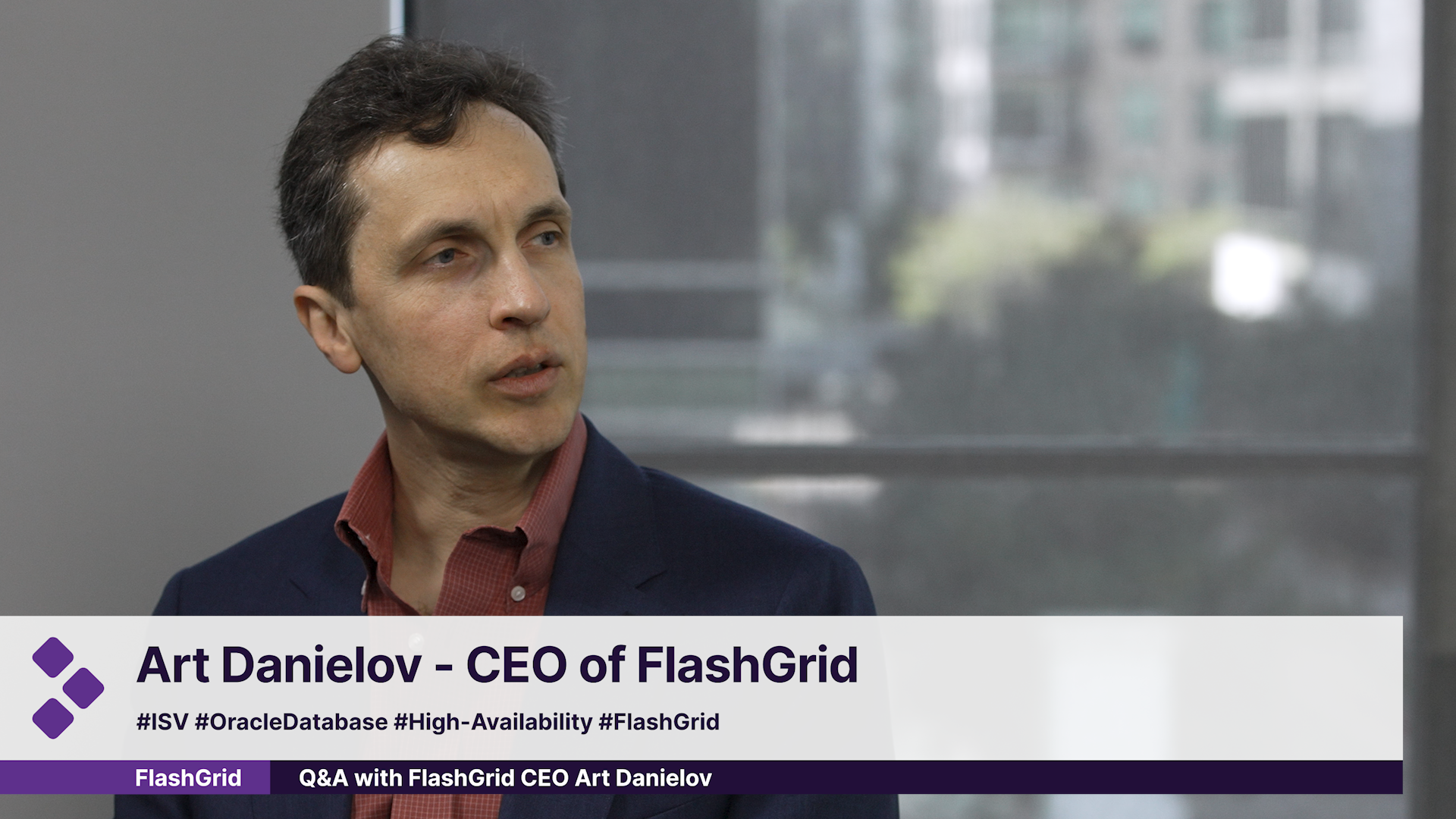
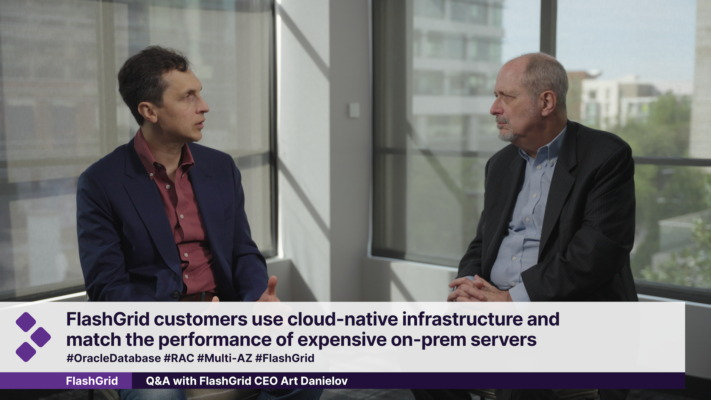
Art, can you please introduce yourself and FlashGrid?
Sure, I’m a co-founder and CEO of FlashGrid.
We are a software vendor based in the heart of Silicon Valley, and our software enables Oracle databases to run with the maximum uptime and availability.
And we’ve been on this mission since 2015.
What does FlashGrid do?
First, we make software that enables high availability for Oracle databases, including Oracle RAC in the cloud and in the traditional data centers.
Second, we make tools that make it easier to deploy and maintain those systems.
Third, we provide high quality 24 by seven support, which is very critical for our customers because they rely on these systems to run their mission critical applications.
So with that said, which kind of customers does FlashGrid cater to.
Any customer who has Oracle databases that need to be up and running nonstop, basically mission critical databases.
Who is FlashGrid for?
We work with customers across various segments and across all continents.
That includes financial services, government agencies, transportation, house data records, payments processing.
Basically, anyone who cannot afford to interrupt the those kind of applications unexpectedly.
Art does FlashGrid work with government agencies?
Absolutely.
We have government agencies both in the United States and in other countries as our customers, and we have our products available in AWS and Azure Government clouds.
And we actually are about to launch our products on the new AWS European sovereign cloud.
Art, what is FlashGrid Cluster?
It is a virtual cloud appliance engineered for running Oracle databases in public clouds with near zero downtime.
Why would someone decide to use FlashGrid Cluster?
There are two main scenarios.
The first is a lift-and-shift of an existing Oracle RAC database to one of the public clouds AWS, Azure or Google Cloud.
The second scenario is a greenfield deployment of a mission critical application that has Oracle as the backend database, and also requires very strict uptime SLA.
In both cases we leverage and enable Oracle RAC for database high availability clustering.
How difficult is it to deploy FlashGrid Cluster?
It is actually fully automated and very easy to to do.
Just enter your desired configuration parameters and our online tool called Flash Grid Launcher.
And it will generate an infrastructure-as-code template which you deploy in your target cloud environment.
Basically a few mouse clicks and just wait for it to initialize the entire process takes less than two hours.
What are the advantages of using infrastructure as code for deploying clusters?
Well, infrastructure as code not only allows you to fully automate the process, but also makes the process repeatable and helps you avoid human errors, and this is especially critical for mission critical systems because errors in high availability configurations could be fatal.
What are the advantages of making this easily repeatable?
If you deploy more than one cluster, you don’t want to introduce errors between those configurations.
You deploy once.
You test it, make sure it all works, and then you repeat the process multiple times, whether it’s going from test and dev to prod or deploying from prod to DR, or just deploying multiple clusters in prod with similar configuration.
So is the implication here that some of your customers actually have a lot of Oracle RAC clusters?
Sure.
Well, in the simplest case it may be just one cluster, but it is more typical to have additional clusters for non prod like pre prod environments, but also DR environments in a different cloud region for example.
And a lot of times it’s just separate clusters are being used for separate applications or a separate set of users or separate regions like in different countries.
Is the FlashGrid Cluster solution limited to a single cloud?
No, it is actually available in the top three public clouds: AWS, Azure, and Google Cloud.
And in fact, you could deploy two clusters simultaneously in two of those clouds and just use one as prod, one as DR.
You can do that.
And we also have customers who initially deployed in one of those clouds and then moved to another cloud.
So it is also portable.
The architecture is essentially the same.
So it’s very easy to move between the clouds.
Where does one purchase FlashGrid Cluster?
Well, you can find it on AWS, Azure and Google Cloud marketplaces, and it is actually full self-service.
So you can just go ahead and subscribe and deploy without even talking to us.
But of course, we encourage you to talk to us first so we can guide you through the entire process.
So customers don’t need to purchase this through you.
They can purchase it through one of these clouds that they already have accounts and relationships with?
That is correct.
The entire billing is done by those cloud vendors through the marketplace, and we just help you with the support therefore when you need it.
So that makes it easier for companies to launch this because they don’t need to get into complicated vendor agreements.
Right?
Absolutely.
It’s just click on the button to subscribe and off you go.
There is no paperwork to worry about.
Does FlashGrid offer proof of concept trials?
Absolutely.
The majority of our customers started with a proof of concept, and that’s what we encourage to do as the first step.
And we can do it free of charge.
And we will offer full support during the trial.
And you can do it as a full self-service.
You don’t even have to talk to us.
But of course, we do encourage you to talk to us so we can help you with sizing and any configuration questions, and we’ll just guide you through the entire process to make it as seamless and quick and successful as possible.
Does FlashGrid have a customer success team with Oracle expertise?
Yes we do.
Even though our products technically are infrastructure products, but because we focus on Oracle databases, our entire customer success team has a lot of knowledge in the Oracle database space.
And we speak Oracle language.
So we can help not only with infrastructure related questions, but also with a lot of Oracle integration questions too What does it mean when FlashGrid says their solutions are DBA friendly?
Well, you get a familiar environment as Oracle RAC Oracle ASM cluster where you get to keep the standard Oracle tools such as RMAN, Data Guard, Golden Gate Enterprise Manager.
You use the standard process for patching.
You have easy process for storage expansion.
And we also have a support team that has very deep Oracle expertise ready to help you.
If you have any questions or issues that you need help with.
What is Multi-AZ RAC and why does it represent such a big breakthrough for enterprises that are running RAC?
Well, in a more traditional Oracle RAC setup you have a cluster that protects you against failures of separate physical servers.
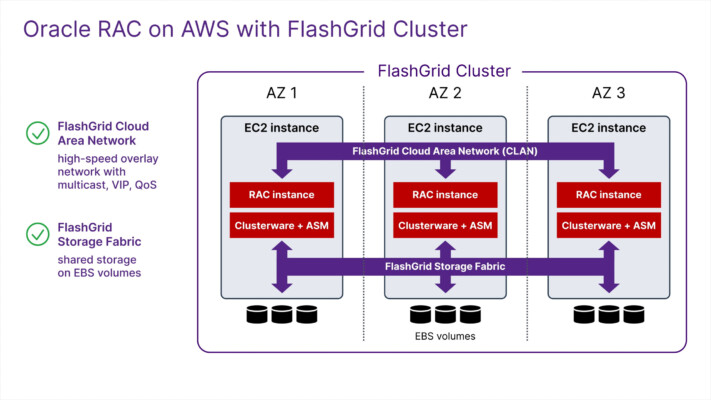
With Multi-AZ RAC, we take it to the next level and you get protection against failures of an entire data center, and that aligns well with the Multi-AZ HA best practices from all the cloud vendors.
So you don’t have to rely on DR to protect you against availability zone or data center outages.
And that’s important because those outages do happen.
Not very often, but they do happen.
Then you do not want to be in position to engage a full DR plan in that case.
Art, can you give us an overview of FlashGrid’s portfolio of solutions for Oracle Database?
Sure.
FlashGrid Cluster is the product that enables high availability clustering for Oracle databases and AWS, Azure and Google Cloud environments.
It can be used for both Oracle RAC and Failover HA databases.
And it can enable uptime slays of four nines or even five nines.
And also importantly, it allows you to use Multi-AZ clustering.
FlashGrid Server is the product that targets single instance databases in the cloud again, AWS, Azure, and Google Cloud and primarily targeted at configurations that leverage Oracle Data Guard for high availability.
And finally, there is FlashGrid Storage Fabric.
It is actually an integral part of FlashGrid Cluster but we also offer it as a standalone product for Oracle RAC clusters in traditional data centers where you enable shared highly available storage without the need for a traditional storage area network products such as Dell EMC or NetApp.
So how does one migrate Oracle databases to the cloud?
Well, first you need to deploy the infrastructure that will be running your Oracle databases, whether it’s a single instance database or an Oracle RAC cluster, FlashGrid can help you do that with a FlashGrid Cluster or FlashGrid Server products.
And then the second step is to actually move your data from your existing setup to the new setup in the cloud.
And for that you would just use a standard approaches using the standard Oracle tools such as Backup restore with RMAN, data replication with Data Guard, or export and import of your database.
So you have the full menu of choices of how exactly you move the data.
But essentially it is similar to moving your data from one data center to the other if you decided to stay on prem.
So broadly speaking, it’s really not significantly different than how customers have been doing it for many years.
Exactly.
It’s like if you have experience moving or migrating from one data center to another, the process will be very similar except of course, it will depend on the details of your database version, whether you want to upgrade your database or not.
But essentially it is the same.
And the most important part that comes first is how you stop your infrastructure in the cloud.
And that’s where FlashGrid makes it easy.
The first step is the easiest is establishing your database servers or clusters with the help of FlashGrid Cluster or FlashGrid Server.
Can Exadata users migrate to AWS, Azure, and Google Cloud?
Absolutely, and we’ve done it multiple times.
Of course, Exadata is known to be the the fastest database system out there.
But at the same time all these cloud vendors offer very high performance systems, instances, and very high performance storage.
So we can match the performance that you are getting today in on your Exadata systems.
In fact, if you’re running on Exadata High Capacity systems, which means they have spinning hard drives for storage, you may even get higher performance from your storage because in the cloud we utilize 100% flash based storage.
But most importantly, we will help you to make an assessment sizing and will help you confirm that the performance you are getting in the cloud is at least what you need, maybe even better than what you had before.
Is that one of the benefits of of performing a FlashGrid POC, to be able to match Exadata performance, for example?
Yes.
During the POC, you can confirm not only that you get the functionality that you need, but you also confirm that you are getting the performance that you need.
And of course, that can be done using running some synthetic tests.
Or that can be done by running your actual application or even doing replay of the actual workload that was running on your Exadata using Oracle Real Application Testing.
What is FlashGrid Server?
Well, FlashGrid Server is a virtual cloud appliance that allows you to run a single instance Oracle database on the cloud of your choice AWS, Azure, or Google Cloud and follow the best practices for running Oracle Database reliably.
Of course, you could take a standard virtual machine in one of those clouds with the Red Hat or Oracle Linux operating system, and just install the single instance Oracle database and call it good, and it will work well until it fails.
And it may fail in an unexpected way.
And you will have to learn from your mistakes.
You have to do all the troubleshooting.
And most importantly, you can disrupt any type of HA setup that you have on top of that database.
More specifically, if you rely on Data Guard for high availability, that’s where things may go wrong because you need fast failure isolation.
And if you have, for example, an out of memory situation on your database server, your Data Guard setup may not help you.
You might have an entire database service outage.
So we implement the the additional services that are part of our active reliability framework that protect against and prevent a lot of failures, but also when the failures happen, we provide fast failure isolation to protect your larger HA setup.
What is Active Reliability Framework?
So Active Reliability Framework is a set of services that we run on FlashGrid Server and also FlashGrid Cluster that were developed over years.
And that’s essentially provide better reliability to your database servers, things like protecting again and preventing various failure modes such as related to storage, network disruptions, out of memory situations, even CPU failures.
In a simple case, you would expect that if one of those failures happen, your database server will simply just go down and then another database server, assuming you have some sort of HA setup, will take over.
Usually that’s not the case, because those a lot of those failures may be very, unclean, so to speak, and your database server may simply get stuck and your entire HA setup may get stuck.
So your database service may go down.
With Active Reliability Framework, we ensure not only that the failures are much less likely to happen in the first place, but also when they happen.
We do fast isolation of those failures, and the failures do not spread to the other parts of your HA setup.
Do you support HA architectures with FlashGrid Server?
Yes.
And in fact, this is the primary use case for FlashGrid Server.
It’s even that server by itself enables a single instance database on one of the cloud instances, but the primary use case for it is being a part of a larger DataGuard setup, where the FlashGrid server by itself runs a single instance database but then at the Oracle database level, you have high availability replication between two or more database instances.
What are the performance and capacity boundaries?
The performance wise, we leverage all the performance that the native cloud instances and native cloud storage can provide, and we have pretty broad range of cloud instance sizes, starting from as small as just for physical cores and going up to hundreds of cores.
While at the storage level, we again can leverage the full storage throughput that a cloud instance can provide.
Today that’s above ten gigabytes per second per instance, and with newer instances, it’s growing.
The good thing is that we can have multiple disks attached per instance.
So we get the aggregate performance of those multiple disks.
We’re not limited to the performance of a single disc.
And in the case of clustering or like with Oracle RAC we also have the aggregate performance of multiple instances and multiple disks across those instances.
So it can be two x, three x or even more of what a single cloud instance can provide with Flash grid server.
With FlashGrid Server, what are the capacity boundaries?
There are no strict boundaries that FlashGrid would impose.
You can have a very small database size, just maybe a few hundred gigabytes, but you can also have a very large database up to hundreds of terabytes, or potentially even more than a petabytes of data, depending on the specific capacity you need.
We can have a simpler setup, which let’s say 2 or 3 nodes, or we can have an extra large setup, which is a scale out setup that can give you not just the capacity, but also the storage throughput that is typically needed to support that larger capacity.
My understanding is some customers like governments, departments of defense, other similar enterprise customers have additional security features.
How does FlashGrid deal with these unique requirements?
We deal with that in two different ways.
First, we actually make it easier to do security hardening.
So if you tell us that you want your environment hardened, there is an easy way to achieve that.
So it’s essentially available out of the box.
And the second approach is that, well, these systems are actually appliances, but they are open appliances, which means that you can do your own security hardening the way that fits your specific requirements.
And we will help you in that process.
So you do it to your own standards.
In which cloud regions is FlashGrid available?
Essentially in all cloud regions of AWS, Azure and Google clouds, and that includes the commercial regions.
It also includes the government cloud regions in the case of AWS Government Cloud and Azure Government Cloud.
It also includes AWS China and Azure China regions.
And also we are about to launch in the new AWS European Sovereign cloud.